
Life Insurance Premiums: 9 Essential Factors That Can Increase or Reduce Your Cost (Easy Guide)
Life insurance premiums can feel confusing because two people of the same age can pay very different amounts for similar coverage. In most cases, the difference isn’t random. It comes from how insurers estimate risk (the chance of a claim) and expected cost (how much they may need to pay), plus the coverage choices you make.
In this beginner-friendly guide from Insurance & Finance Education (operated by Kehost Team), you’ll learn what a premium is, the main pricing factors behind life insurance premiums, why insurance cost varies by person, and practical ways to manage costs safely—without quotes, brands, or sales language.
1. A Simple Introduction Explaining the Topic in Plain Language
Life insurance is designed to protect people who depend on you financially. If you pass away while the policy is active, the policy may pay money to your beneficiaries (the people you choose). That payment can help cover real needs like daily expenses, outstanding debts, education plans, or other responsibilities.
To keep that protection active, you pay a regular amount called a premium. So why do life insurance premiums differ so much from person to person?
Insurers are usually trying to estimate two basic things:
- How likely is a claim during the policy period?
- How expensive could that claim be?
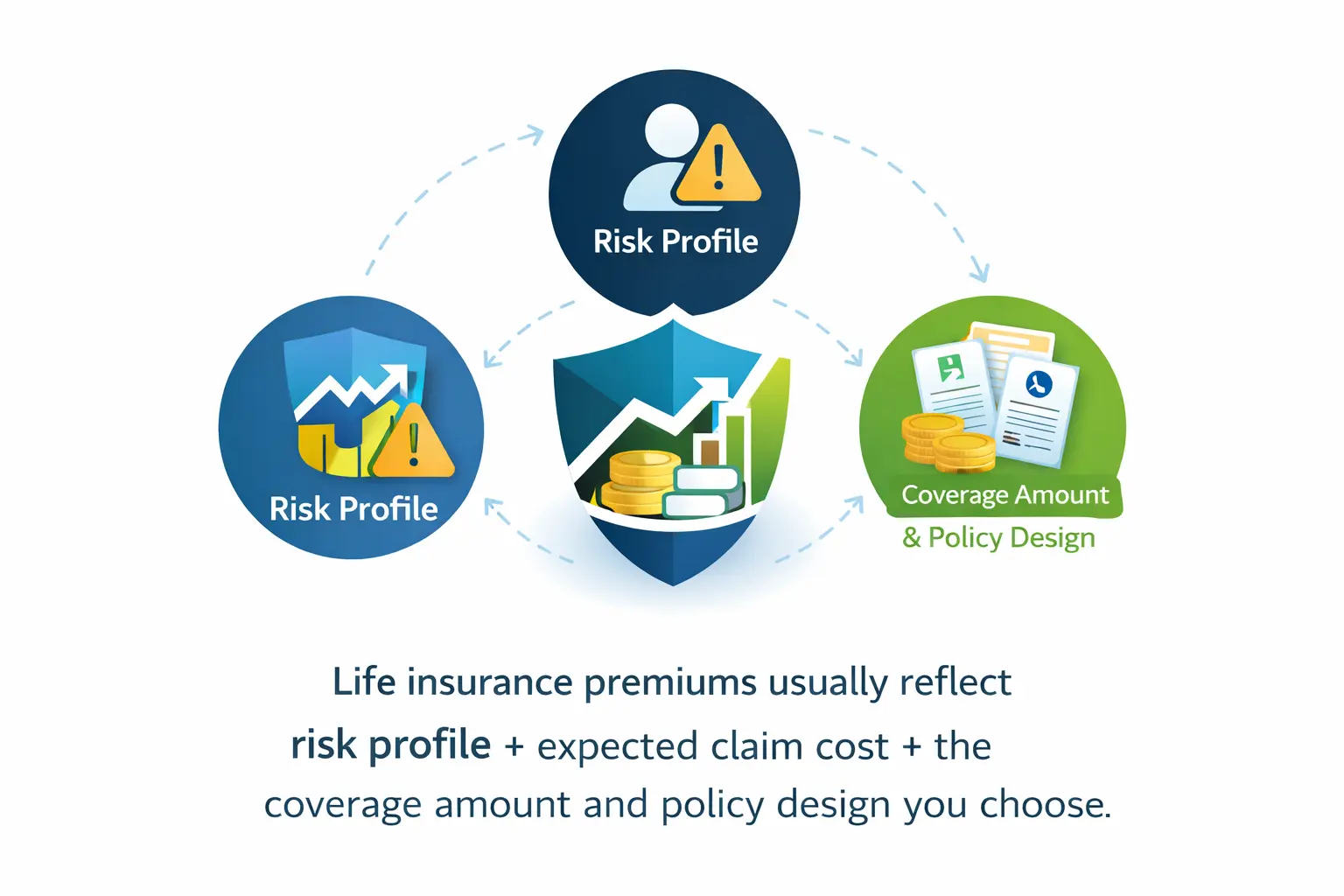
Your premium is shaped by your risk profile (health and lifestyle risk signals) and your policy design (coverage amount, duration, and any optional features). That combination is why life insurance premiums can differ even among people who feel “similar.”
3. The 9 Pricing Factors That Usually Determine Life Insurance Cost
Life insurance pricing factors can vary by country and product design, but the categories below are common globally. Together, they shape your risk profile and the insurer’s expected claim cost—both of which drive life insurance premiums.
1) Age
Age is one of the strongest drivers of life insurance premiums. In general, the likelihood of serious illness and death increases with age, so the expected claim risk rises too.
2) Current health and medical history
Insurers often consider your health stability and medical history (for example, chronic conditions, ongoing treatment, or past major issues). This is used to estimate risk during the coverage period—not to judge you.
3) Tobacco or nicotine use
Tobacco and nicotine use is a major pricing factor in many markets because it is linked with higher health risks. This can raise life insurance premiums noticeably compared with non-users.
4) Lifestyle and long-term habits
Some lifestyle habits may affect risk estimates in certain underwriting systems (for example, patterns that indicate higher long-term health risk). The impact varies widely by policy rules and region.
5) Coverage amount (benefit size)
The larger the benefit you choose, the higher the potential payout. A higher benefit often increases insurance cost because the insurer’s maximum expected obligation is larger.
6) Policy length (term duration) and age at expiry
Term length matters because it affects time exposure. Longer terms often increase the chance a claim occurs while the policy is active, which can increase life insurance premiums.
7) Policy type and structure
Different policy structures can be priced differently. Some are designed for temporary protection (often called “term”), while others are designed for lifelong coverage (often called “permanent”) and may include added features. The details vary widely by market.
8) Occupation and work-related risk
Some jobs involve higher physical risk (for example, heavy machinery or working at heights). If the job increases accident risk, it can influence life insurance premiums in some underwriting systems.
9) Underwriting method (medical exam vs simplified questions)
Some policies use detailed health checks (including exams or lab tests), while others use simplified questionnaires. Pricing can differ because the insurer is working with different levels of information to estimate risk.
Key takeaway: most life insurance premiums reflect a mix of your risk profile and your coverage design. That’s why two people can have different premiums even when they both want “life insurance.”
4. Why Life Insurance Premiums Vary From Person to Person
Life insurance premiums vary because people are not identical in risk, and they also choose different coverage structures. Even small differences in health history, habits, or coverage duration can change expected claim cost.
Premium differences commonly come from:
- Different risk profiles: age, health stability, tobacco use, occupation, lifestyle factors
- Different coverage design: benefit amount, term length, and policy type
- Risk grouping: insurers often place applicants into categories based on observed claim patterns
- Timing: applying younger vs later can change pricing as risk changes over time
So the premium is not “one universal price.” It’s a personalized estimate of expected claim costs plus policy structure.
5. General Cost Ranges Explained Carefully (No Exact Prices)
Many beginners ask about the average cost of life insurance. The most accurate answer is that it varies widely and depends on multiple factors—especially age, health, coverage amount, and term length.
Instead of focusing on exact prices (which can mislead in a global audience), it’s more helpful to understand typical patterns:
- Often lower-cost situations: younger applicant, stable health history, non-smoker, moderate benefit amount, shorter term.
- Often higher-cost situations: older applicant, certain health conditions, tobacco use, higher benefit amount, longer term, higher-risk job or activities.
Also note: “average cost” in one region may not translate well to another due to different medical cost patterns, regulations, and product designs. For learning, the goal is understanding why premiums change—not memorizing a number.
6. How Coverage Choices Affect Total Cost (Amount, Term, Limits, and “Deductible Impact”)
Many premium surprises come from coverage design rather than “mystery pricing.” The choices below often have a direct effect on total insurance cost.
Coverage amount (your benefit limit)
In life insurance, the main coverage limit is usually the benefit amount—the maximum that may be paid if a covered claim happens. Higher benefit amounts often increase life insurance premiums because the potential payout is larger.
Term length (how long coverage lasts)
Longer terms often increase premiums because coverage lasts longer and risk increases over time. Shorter terms may cost less, but they can end while responsibilities still exist.
Optional features (often called riders)
Optional add-ons can increase premiums because they expand what the policy may pay for or how it works. The key is to understand the exact conditions and limits of any add-on.
What about “deductible impact”?
You’ll often hear about deductible impact in car or health insurance (where you pay part of a claim first). Life insurance usually does not work with a deductible in the same way. Instead, life insurance premiums are more influenced by risk profile, benefit amount (coverage limit), and policy duration.
Bottom line: total life insurance cost is largely shaped by (1) your risk profile and (2) how big and how long your coverage is.
7. Common Misconceptions People Have About Life Insurance Pricing
Misconception 1: “Premiums are based only on age.”
Age matters, but health history, tobacco use, coverage amount, term length, and underwriting method can also affect life insurance premiums.
Misconception 2: “If I’m healthy today, my pricing will always be the same.”
Health can change, and applying later can change pricing. Different product designs also handle premium stability differently.
Misconception 3: “Cheaper premiums always mean better value.”
A lower premium can reflect a smaller benefit amount (lower coverage limit), shorter term, or fewer features. Price alone doesn’t tell you if coverage matches your goal.
Misconception 4: “Life insurance is only for parents.”
Life insurance is most relevant when someone would face financial harm if you died—spouses, children, extended family, business partners, or others who rely on your support.
Misconception 5: “If I never claim, I wasted money.”
Insurance is protection against rare but expensive outcomes. Not needing a claim can simply mean life went well.
8. Practical, Non-Sales Tips for Managing or Reducing Premiums Safely
These tips are educational. They focus on improving risk signals and choosing coverage thoughtfully—without pushing brands, quotes, or “buy now” language.
1) Start with a clear purpose
Know what the policy is meant to protect: dependents’ income support, debt coverage, education, or stability. Clear purpose helps you avoid paying for coverage that doesn’t match your real goal.
2) Improve the controllable parts of your risk profile
Some pricing factors can’t be changed (like age). Others may be influenced over time (for example, tobacco use and certain health habits). Improving controllable risk signals can support more stable life insurance premiums in many systems.
3) Choose a realistic coverage amount
Higher benefit amounts (higher coverage limits) usually increase insurance cost. Instead of guessing, list real responsibilities your beneficiaries could face, then choose a coverage amount that fits that reality.
4) Match term length to your timeline
Pick coverage duration that aligns with real obligations (for example, years until children are independent or major debts are paid). Shorter terms can reduce premium, but only if they still match the need.
5) Avoid paying for features you don’t understand
Optional features can increase premiums. If you don’t clearly understand what an add-on covers, it’s hard to judge whether it fits your situation.
6) Review when life changes
Marriage, children, new debts, major income changes, or business responsibilities can change what coverage you need. A simple annual review helps keep coverage aligned with real life.
If you want a broader foundation that supports better insurance decisions, read:
Financial Literacy: Why It Matters (Beginner Guide).
FAQ
What determines life insurance premiums the most?
The biggest drivers are usually age, health status, tobacco/nicotine use, coverage amount (coverage limit), and how long the coverage lasts. Other pricing factors can include occupation, activities, and underwriting method.
Why can two people of the same age pay different life insurance premiums?
Because risk profiles can still differ—health history, tobacco use, lifestyle signals, occupation, coverage amount, term length, and underwriting results can all change premium.
What does “average cost” mean for life insurance?
Average cost is a broad statistic that varies widely by country, product type, and applicant group. It can provide general context, but it won’t predict a specific person’s premium.
Does life insurance have deductible impact like car insurance?
Usually no. Deductible impact is common in car and health insurance, but life insurance pricing is typically more driven by risk profile, benefit amount, and policy duration.
How can I reduce life insurance cost safely?
Safer approaches often include improving controllable risk factors (like tobacco use), choosing a realistic coverage amount, matching term length to real obligations, and avoiding add-ons you don’t understand.