
What Is Risk? Simple Meaning + 7 Real Examples (Beginner Guide)
Risk is the chance that something uncertain will happen and affect you—usually through a loss, cost, harm, or delay (and sometimes through a positive opportunity).
In this beginner-friendly guide from Insurance & Finance Education (operated by Kehost Team), you’ll learn what risk means in simple words, how to spot it in real life, the difference between risk and uncertainty, and why understanding risk helps you make smarter decisions about safety, savings, and insurance cost.
1. Simple Introduction Explaining the Topic in Plain Language
Every day includes “what if” moments:
- What if your phone gets stolen?
- What if you get sick unexpectedly?
- What if your car gets damaged?
- What if you lose income for a few months?
Those “what ifs” are risk. Some risks are small and easy to handle. Others are rare but expensive. Understanding risk helps you prepare calmly—using safer habits, small savings for minor problems, and insurance for the big losses that could overwhelm your finances.
If you want a beginner explanation of how insurance handles large risks, you can read:
How Insurance Works: Premiums, Risk Pooling & Claims.
2. What Is Risk? (Simple Definition)
What is risk? In simple words: risk means there is a chance something will happen, and if it happens it can create a result that matters to you (often a loss or cost).
A very useful beginner formula is:
- Risk = likelihood (chance) × impact (consequence)
You don’t need advanced math. Just remember:
- Likely + small impact is still a risk (for example: frequent small expenses).
- Rare + huge impact is also a risk (for example: a serious accident).
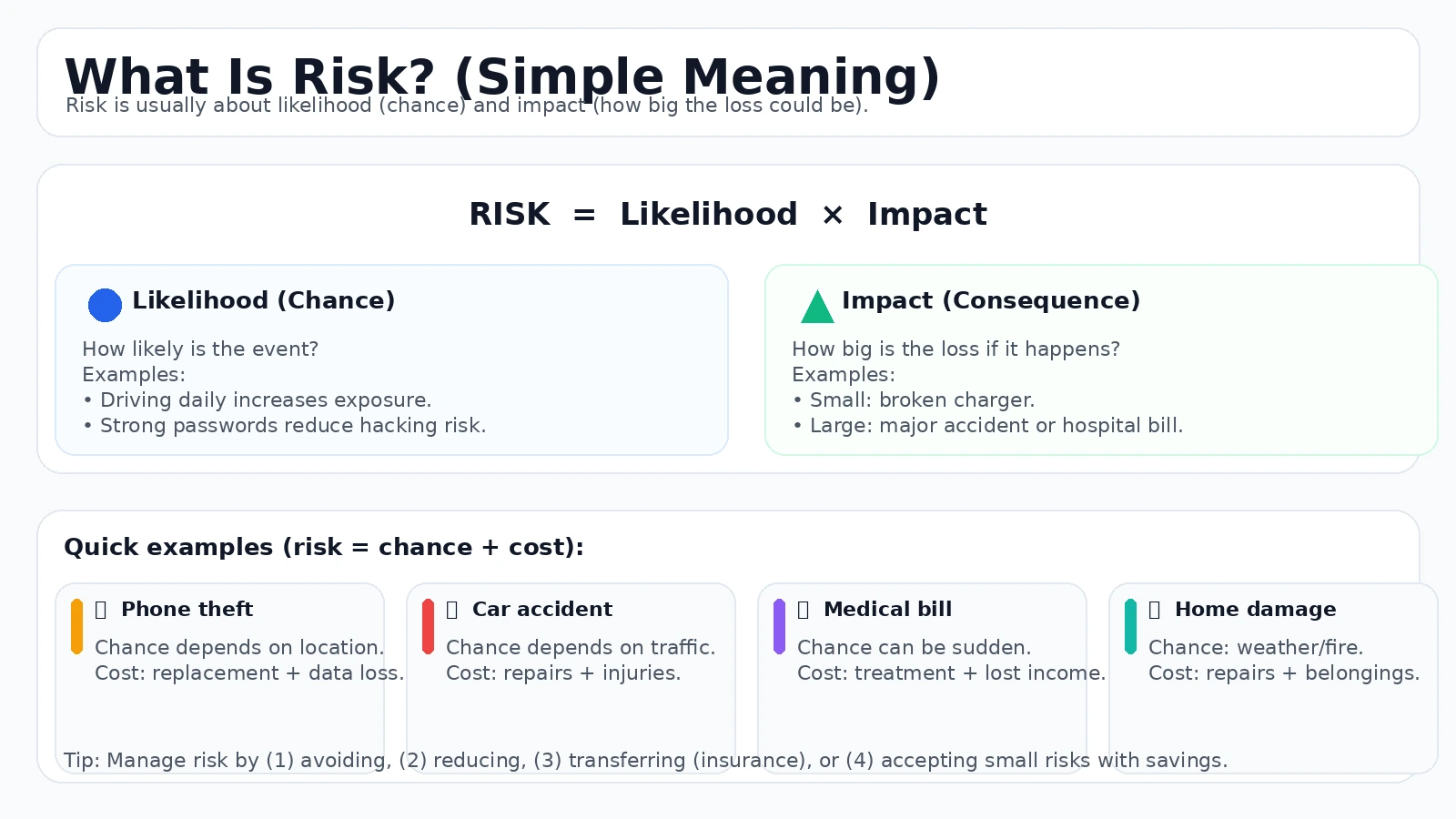
3. The 3 Parts of Risk (Likelihood, Impact, Time)
Most real-world risks become clearer when you break them into three parts:
1) Likelihood (How likely is it?)
This is the probability of the event happening. Example: if you drive daily in heavy traffic, the chance of small incidents may be higher than if you rarely drive.
2) Impact (How bad would it be?)
This is the size of the loss if it happens. Some events are annoying but affordable. Others can be financially severe (major medical bills, large property damage, or long recovery time).
3) Time (When could it happen?)
Some risks are immediate (a slippery floor today). Others build slowly (debt growing due to interest, health risks from long-term habits).
Why time matters: a small risk repeated many times can become a big long-term cost.
4. Risk vs Uncertainty (Easy Difference)
People often mix these up, so here’s an easy way to separate them:
- Uncertainty = you don’t know what will happen.
- Risk = that uncertainty can cause a meaningful impact (loss, cost, harm, delay).
Example:
- Uncertainty: “Will it rain tomorrow?”
- Risk: “If it rains tomorrow, my outdoor event could be ruined and I may lose money.”
If you want a simple external definition of “risk,” this dictionary entry is helpful:
Cambridge Dictionary: risk.
5. 7 Real Examples of Risk (Daily Life + Money)
Each example below has two parts: (1) a chance of happening and (2) a possible cost or harm if it happens.
Example 1: Phone theft (property risk)
Likelihood: depends on travel habits, storage, and environment.
Impact: replacement cost + lost data + time stress.
Example 2: Medical emergency (health risk)
Likelihood: often unpredictable.
Impact: can be high due to treatment costs and lost income.
Example 3: Car accident (auto risk)
Likelihood: influenced by driving frequency, road conditions, and habits.
Impact: repair costs + injury costs + legal/third-party costs (depending on the situation).
Example 4: Fire or water damage at home (property/environment risk)
Likelihood: influenced by building conditions, wiring, cooking habits, local hazards, and weather.
Impact: repairs + replacement of belongings + temporary living disruption.
Example 5: Job loss or income drop (income risk)
Likelihood: varies by industry and circumstances.
Impact: difficulty paying essentials, debts, or school costs.
Example 6: High-interest debt growing (financial risk)
Likelihood: high if minimum payments are the only plan.
Impact: total repayment increases over time and can damage long-term stability.
Example 7: Online account hacking (cyber risk)
Likelihood: higher with weak passwords and password reuse.
Impact: stolen funds, identity issues, lost access, and time-consuming recovery.
Quick lesson: some risks are mostly about frequency (happen more often but are smaller). Others are mostly about severity (rare but huge). Smart planning considers both.
6. How Risk Affects Insurance Premiums and Insurance Cost
Insurance is closely connected to risk because it is designed to handle losses that are too large for most people to comfortably pay alone.
When insurers calculate a premium, they often estimate:
- Claim frequency: how often losses happen in similar situations
- Claim severity: how expensive those losses tend to be
- Coverage design: how the policy shares costs (deductibles, coverage limits, exclusions)
Risk profile (simple meaning)
Your risk profile is a summary of risk-related details—like how an asset is used, where it’s used, past claim patterns (where relevant), and the environment around it.
Average cost (general) vs your cost
People often search for the “average cost” of insurance. But averages are broad. Your premium can be higher or lower because it depends on multiple pricing factors plus your coverage choices.
Related internal guide:
Why Car Insurance Premiums Differ by Driver.
To learn the key policy words that control cost sharing, see:
Key Insurance Terms Explained (Premium, Deductible, Limit, Exclusion).
7. Simple Risk Management Steps (Avoid, Reduce, Transfer, Accept)
Risk management is not about fear. It’s about smart choices based on likelihood and impact.
1) Avoid the risk (remove the situation)
If a risk is unnecessary and dangerous, the simplest solution is to avoid it. Example: don’t use unsafe shortcuts or share sensitive codes.
2) Reduce the risk (lower likelihood or impact)
Use habits and safeguards that reduce accidents, theft, and preventable losses (defensive driving, smoke alarms, maintenance, strong passwords).
3) Transfer the risk (share big losses)
This is where insurance often fits: it transfers part of the financial risk to an insurer, based on the policy rules and coverage limits.
4) Accept the risk (when it’s small and manageable)
Not every risk needs insurance. Small risks may be cheaper to handle with savings. This is also why deductible impact exists in many policies: you may agree to handle smaller losses yourself to keep premiums lower.
Helpful mindset: save for small problems, insure for big problems, and reduce risk with habits.
8. Common Misconceptions About Risk
Misconception 1: “Risk only means danger.”
In everyday language, risk often means danger. Technically, risk is uncertainty with impact. In insurance, the focus is mainly on potential losses and claim costs.
Misconception 2: “Low likelihood means no risk.”
Rare events can still be serious if the impact is huge. That’s why people plan for “unlikely but expensive” problems.
Misconception 3: “If I’m careful, risk disappears.”
Careful habits reduce risk, but they don’t eliminate it. Weather, other people, and random events still exist.
Misconception 4: “Insurance covers everything, so I don’t need to think about risk.”
Insurance policies include exclusions, limits, and conditions. Understanding risk helps you avoid false confidence and reduces surprises later.
9. Practical Tips to Handle Risk (Without Fear)
1) Separate “likely” risks from “severe” risks
Likely risks need habits and small savings. Severe risks need stronger planning (and sometimes insurance) because one event can cause major damage.
2) Build a small emergency buffer
An emergency fund helps with deductibles, temporary income gaps, and unexpected costs. Even small savings can reduce stress.
3) Reduce avoidable exposure
Exposure means how often you are “in the situation” where a loss could happen. Safer routines and secure storage reduce risk over time.
4) Learn key insurance terms
Understanding premium, deductible, coverage limits, and exclusions helps you understand what risk is transferred and what risk remains with you.
5) Use simple rules instead of perfection
You don’t need perfect planning. A simple plan repeated consistently is usually better than complicated plans you never follow.
Optional external reading on general risk (broader, not insurance-specific):
Britannica: Risk (overview).
FAQ
What is risk in simple words?
Risk is the chance that something uncertain will happen and cause an outcome that matters to you—often a loss, cost, harm, or delay.
What is an easy example of risk?
Phone theft is a clear example: it might happen (chance), and if it happens you could lose money and data (impact).
How does risk relate to insurance premiums?
Insurance premiums often reflect risk profile and expected claim costs. If the chance of claims or the likely cost of claims is higher, premiums can be higher—depending on pricing factors and coverage choices.
Is risk always bad?
Risk is uncertainty with impact. In insurance, the focus is mainly on potential losses, so it’s usually discussed as a negative possibility.
How do I manage risk simply?
A simple method is: avoid unnecessary risks, reduce risks with safer habits, transfer large risks with insurance where appropriate, and accept small risks using savings.