
How Insurers Calculate Premiums: 9 Simple Steps (Beginner Guide)
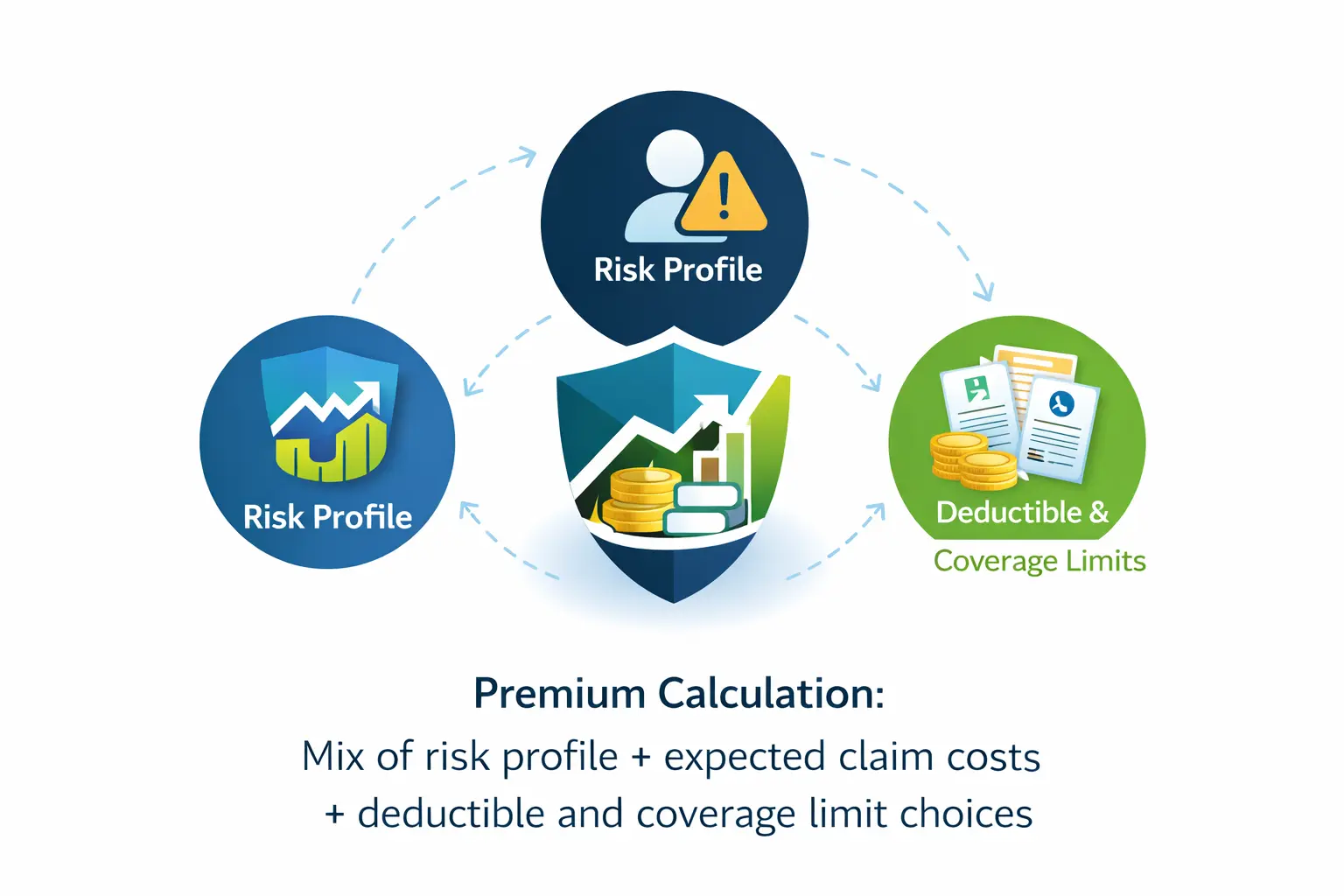
Insurance premiums are the regular payments you make to keep an insurance policy active. Many beginners wonder: “How do insurers decide the premium?” The short answer is that insurers estimate insurance cost by combining your risk profile (how likely a claim is) with the expected claim cost (how expensive that claim could be), then adjusting for your coverage choices.
In this calm, beginner-friendly guide from Insurance & Finance Education (operated by Kehost Team), you’ll learn what premiums mean, the most important pricing factors, why premiums vary from person to person, how deductible impact and coverage limits change what you pay, and practical ways to manage costs safely—without quotes, brands, or sales language.
1. A Simple Introduction Explaining the Topic in Plain Language
Insurance exists to reduce the financial shock of expensive problems. Instead of paying the full cost of a major loss alone, you pay a smaller, predictable amount over time (the premium). If a covered event happens, the insurer may help pay according to the policy rules.
To calculate a premium, insurers try to answer two basic questions:
- How likely is a claim to happen during the policy period?
- How expensive might that claim be if it happens?
They use data from many similar situations to estimate probability and cost. Then they adjust for your situation and your choices (deductible, limits, and what coverage is included). That’s why two people can pay different premiums for what seems like “the same insurance.”
If you want a quick foundation on what insurance is and why people use it, see our internal beginner guide:
What Is Insurance? 7 Simple Facts for Beginners.
3. Key Factors That Influence Insurance Costs
Pricing factors vary by product type (auto, health, home, life, travel) and by country rules, but the broad categories below are common worldwide. Together, they shape your risk profile and the expected cost of claims.
A) Person-related factors
Age and experience
In many types of insurance, age and experience can change expected claim frequency or severity. For example, new drivers often have less experience with hazards, and certain age groups may show different claim patterns depending on product type and local conditions.
Claims history and behavior signals
Insurers often consider past claims, serious violations (where applicable), or patterns that correlate with future claims. The goal is not punishment—it’s forecasting expected costs based on evidence.
Typical usage and exposure
Exposure is how often you face risk. In auto insurance, higher mileage or frequent driving in heavy traffic may increase exposure. In property insurance, exposure may relate to how and where a property is used and maintained.
B) Location-related factors
Local claim patterns
Location can influence claim frequency and claim severity. Different areas can have different accident rates, theft risk, weather-related losses, and even different repair or medical costs—affecting the overall insurance cost.
Environmental and weather risks
Some locations face higher risk of floods, storms, wildfires, or hail. If severe events are more likely or more costly, average claim costs may rise, which can affect premiums.
C) Item or asset-related factors
Replacement and repair cost
When the insured item costs more to repair or replace, claim severity can be higher. This matters for vehicles, homes, phones, and many other insured items.
Safety and security characteristics
Safety features and security measures may reduce claim likelihood or reduce how severe losses are. The impact varies widely by policy design and by how strongly the feature correlates with fewer or cheaper claims.
D) Policy and coverage factors
Coverage breadth (what is included)
Broader coverage typically costs more because it increases the number of situations where the insurer may pay. Narrower coverage may lower the premium but may leave more out-of-pocket risk.
Deductible impact
The deductible impact is often significant. If you choose a higher deductible (meaning you pay more first during a claim), the premium is often lower. A lower deductible can increase premiums because the insurer may pay more often, including for smaller losses.
Coverage limits
Coverage limits are maximum payout amounts under different parts of a policy. Higher limits can increase the premium because the insurer may have to pay more in a severe claim.
Key idea: insurers don’t use just one factor. Premiums are usually the result of multiple pricing factors combined.
4. Why Insurance Premiums Vary From Person to Person
Even when two people appear similar, their premiums can differ because insurance pricing aims to match expected costs to the specific risk situation. Premiums may vary due to differences in:
- Probability: how likely a claim is based on risk profile and exposure
- Severity: how expensive a claim could be (repairs, medical costs, replacements)
- Local cost levels: labor, parts, healthcare, legal frameworks, and claim trends
- Coverage structure: deductible impact, coverage limits, and what is included/excluded
- Risk grouping: insurers typically group similar risk profiles based on observed outcomes
This is why “average cost” (general) is not a personal prediction. It’s a broad statistic that may not reflect your situation or your coverage choices.
If you want a real-world example of why two drivers can pay different amounts, see:
Why Car Insurance Premiums Differ by Driver.
5. General Cost Ranges Explained Carefully
Beginners often ask: “What’s the average cost of insurance?” The safest educational answer is that it varies widely and depends on multiple factors—including where you live, the type of coverage, the deductible you choose, and the coverage limits.
Instead of focusing on exact prices (which can quickly become outdated or misleading), it helps to compare general scenarios:
- Often lower-cost situations: lower exposure, fewer risk signals, lower expected claim costs, higher deductibles, moderate coverage limits.
- Often higher-cost situations: higher exposure, more risk signals, higher expected claim costs, lower deductibles, higher coverage limits or broader coverage.
Also, the “average cost” in one country or region may not be meaningful in another. Local rules, claim patterns, and the cost of repairs or medical treatment can differ greatly.
Better question than “What’s the price?” Ask: “What factors are increasing my expected claim cost, and what policy choices are changing my out-of-pocket risk?” That approach leads to clearer understanding.
6. How Deductibles, Limits, and Coverage Choices Affect Total Cost
Many people focus only on the premium, but total insurance cost is broader than that. It includes what you may pay later if a claim happens.
Deductible impact (what you pay first)
A deductible is the amount you pay out of pocket before the insurer pays on a covered claim (where a deductible applies). The deductible changes how costs are shared.
- Higher deductible: often lowers the premium, but increases your out-of-pocket cost if you claim.
- Lower deductible: often raises the premium, but lowers your out-of-pocket cost if you claim.
Beginner-friendly rule: A deductible should be “annoying but affordable.” If paying it would force debt or create financial crisis, it may be too high—no matter how attractive the premium looks.
Coverage limits (how much the policy may pay)
Coverage limits are maximum amounts the policy may pay under different parts of coverage. Higher limits can mean better protection in severe events, but they often increase the premium because they increase potential payout.
Why this matters: Low limits may reduce premium, but they can increase your financial exposure in a major loss. Premium savings can look small compared with the cost of a severe incident.
Coverage choices (breadth and exclusions)
Coverage choices determine what is included, what is excluded, and the conditions for payment. Broader coverage usually increases premium, while narrower coverage may lower premium but shift more risk to you.
Bottom line: Two premiums can’t be compared fairly unless the coverage limits, deductibles, and what is included are comparable.
7. Common Misconceptions People Have About Insurance Pricing
Misconception 1: “My premium should match someone else’s.”
Even if your situations look similar, small differences in location, claims history, exposure, deductible impact, and coverage limits can change expected claim costs.
Misconception 2: “Premiums are random.”
Premiums are usually data-based estimates. While no model is perfect, pricing is typically built around claim probability, claim severity, and policy structure.
Misconception 3: “Cheapest premium is automatically best.”
A low premium can come with a high deductible, low coverage limits, narrower coverage, or more exclusions. Price alone does not describe protection level.
Misconception 4: “If I pay premiums, every claim must be paid.”
Claims depend on the policy rules: deductibles, limits, exclusions, required reporting, documentation, and whether the event is covered.
Misconception 5: “If I never claim, I wasted my money.”
Insurance is mainly protection against rare but expensive losses. Not needing to claim can mean you avoided a major financial shock.
8. Practical, Non-Sales Tips for Managing or Reducing Insurance Costs Safely
These tips are educational and general. They focus on safer cost management, not cutting protection to an unsafe level.
1) Improve your risk profile where possible
Risk profile is shaped by behavior and exposure. Safer habits (where relevant), fewer incidents, and avoiding risky patterns can reduce claim likelihood over time.
2) Choose a deductible you can truly afford
Deductible impact is real. A higher deductible can lower the premium, but it can become a financial problem if you can’t pay it when needed. Balance premium savings with realistic emergency capacity.
3) Review coverage limits like a protection decision
Coverage limits are not just “numbers.” They define how much protection exists in severe events. Very low limits can create high out-of-pocket exposure. Aim for limits that match your real risk and responsibilities.
4) Avoid comparing premiums without matching coverage
Many “cheap vs expensive” comparisons are unfair because the coverage is different. Compare like-for-like: deductible, limits, what’s included, and key exclusions.
5) Reduce exposure when it’s realistic
In some insurance types, using something less, driving less, or storing assets more securely can reduce exposure. The impact varies, but the principle is simple: less exposure can mean lower claim probability.
6) Keep accurate information up to date
Changes in location, usage, listed drivers, or key details can affect pricing factors. Accuracy supports fair pricing and can reduce claim disputes later.
7) Learn the basics before making big changes
Many cost problems come from misunderstandings. When you understand premium logic, deductible impact, and coverage limits, you can make changes based on understanding—not pressure.
Helpful consumer education (external):
NAIC Consumer Insurance Information
and
Consumer Financial Protection Bureau (CFPB).
9. A Short Educational Disclaimer
Educational disclaimer: This content is for learning only and is not insurance, legal, financial, or investment advice. Insurance pricing factors, coverage limits, and deductible impact vary by country, provider, and policy type. Always read your policy documents for your specific terms and conditions.
FAQ
How do insurers calculate premiums in simple terms?
They estimate how likely a claim is (risk profile) and how expensive it could be, then adjust for coverage choices like deductible impact and coverage limits.
What are the most common pricing factors?
Common pricing factors include age/experience (where relevant), claims history, location risk, exposure (like mileage or usage), asset repair/replacement cost, deductible level, and coverage limits.
Why does the “average cost” not predict my premium?
Average cost is a broad statistic that varies widely across groups and locations. Your premium depends on your risk profile and your coverage choices.
Does a higher deductible always reduce premium?
Often it can, because you agree to pay more out of pocket if a claim happens. But the final premium still depends on multiple pricing factors.
What’s the safest way to manage insurance cost?
Improve risk profile where possible, choose a deductible you can afford, and select coverage limits that reduce major financial exposure—rather than cutting coverage too far.